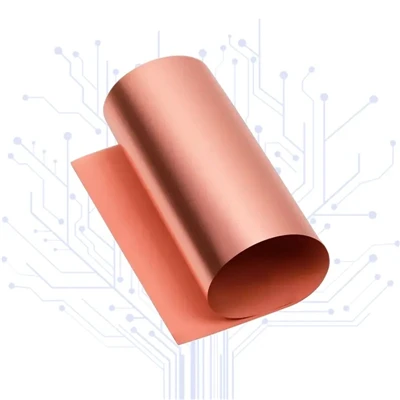
Civen Metal Material (Shanghai) Co., Ltd. is one of the leading manufacturers and suppliers of ed copper foils for fpc in China. Welcome to buy bulk durable ed copper foils for fpc made in China here from our factory. If you have any enquiry about cooperation, please feel free to email us.
Electrolytic Copper Foil for Flexible Circuits
Flexible printed circuit boards use copper foil that must meet the dimensional and processing requirements of the circuit design. For FPC and FCCL production, copper thickness, surface characteristics, bonding performance and resistance to repeated bending are important factors when evaluating a foil grade.
CIVEN Metal ED copper foil for FPC is available in nominal thicknesses of 9, 12, 18 and 35 μm. The product information identifies ductility, surface finish, peel strength and bending resistance as relevant characteristics.
Thickness and Technical Specifications
The listed thickness range is 9–35 μm. The technical table provides data for 9 μm, 12 μm, 18 μm and 35 μm foil, including copper content, area weight, tensile strength, elongation, roughness and peel strength.
These properties should be evaluated together rather than in isolation. A foil selected for a fine-line circuit may have different priorities from one intended for a flexible assembly that undergoes repeated bending.
Review the original performance table for the values associated with each thickness. Test conditions and the manufacturer's stated testing method should be considered when comparing specifications.
Surface Characteristics and Processing
The product page describes the foil surface as black or red and identifies low surface roughness as a characteristic. The page also provides SEM images showing the rough side after treatment, the surface before treatment and the shiny side after treatment.
Surface condition can influence bonding to the substrate and subsequent circuit fabrication. Etching performance, surface finish and peel strength should therefore be considered in relation to the selected laminate and production process.
The product information also states that the electrolytic foil does not contain grease and describes its suitability for combination with TPI materials at high temperatures. Buyers with specific high-temperature processing requirements should confirm compatibility with their own material system and lamination conditions.
Applications
The listed applications for this product include:
• Flexible copper clad laminate (FCCL)
• Fine-circuit flexible printed circuit boards (FPC)
• LED coated crystal thin film
For FPC and FCCL projects, selection should be based on the required foil thickness, substrate compatibility, surface characteristics and bending conditions. Where the circuit design specifies minimum peel strength or a particular roughness limit, those requirements should be confirmed before production.
Selecting Copper Foil for FPC
When requesting a quotation, provide the required thickness, intended substrate, application and any relevant bending or lamination requirements. If the design includes a defined peel-strength or surface-roughness limit, include the target value and test method.
These details help determine whether the listed FPC copper foil specification matches the intended process. Where the application calls for a different surface treatment or mechanical profile, other ED copper foil grades may also be worth comparing.
Microstructure


Table1- Performance (GB/T5230-2000,IPC-4562-2000)
|
Classification |
Unit |
9μm |
12μm |
18μm |
35μm |
|
|
Cu Content |
% |
≥99.8 |
||||
|
Area Weigth |
g/m2 |
80±3 |
107±3 |
153±5 |
283±7 |
|
|
Tensile Strength |
R.T.(23℃) |
Kg/mm2 |
≥28 |
|||
|
H.T.(180℃) |
≥15 |
≥15 |
≥15 |
≥18 |
||
|
Elongation |
R.T.(23℃) |
% |
≥5.0 |
≥5.0 |
≥6.0 |
≥10 |
|
H.T.(180℃) |
≥6.0 |
≥6.0 |
≥8.0 |
≥8.0 |
||
|
Roughness |
Shiny(Ra) |
μm |
≤0.43 |
|||
|
Matte(Rz) |
≤2.5 |
|||||
|
Peel Strength |
R.T.(23℃) |
Kg/cm |
≥0.77 |
≥0.8 |
≥0.8 |
≥0.8 |
|
Degraded rate of HCΦ(18%-1hr/25℃) |
% |
≤7.0 |
||||
|
Change of color(E-1.0hr/200℃) |
% |
Good |
||||
|
Solder Floating 290℃ |
Sec. |
≥20 |
||||
|
Appearance(Spot and copper powder) |
---- |
None |
||||
|
Pinhole |
EA |
Zero |
||||
|
Size Tolerance |
Width |
mm |
0~2mm |
|||
|
Length |
mm |
---- |
||||
|
Core |
Mm/inch |
Inside Diameter 79mm/3 inch |
||||
Note: 1. Copper foil oxidation resistance performance and surface density index can be negotiated.
2. The performance index is subject to our testing method.
3. The quality guarantee period is 90 days from the date of receipt.
If the project requires a different surface treatment, compare RTF Reverse Treated ED Copper Foil. For applications where surface profile is a key consideration, review Very Low Profile ED Copper Foil VLP. Where elongation requirements are more demanding, HTE High Elongation ED Copper Foil may also be relevant.
Hot Tags: ed copper foils for fpc, China ed copper foils for fpc manufacturers, suppliers, factory, BCF Battery ED Copper Foil, ed copper foils, ED Copper Foils For FPC, Shielded ED Copper Foils, Super Thick ED Copper Foils, Very Low Profile ED Copper Foil VLP