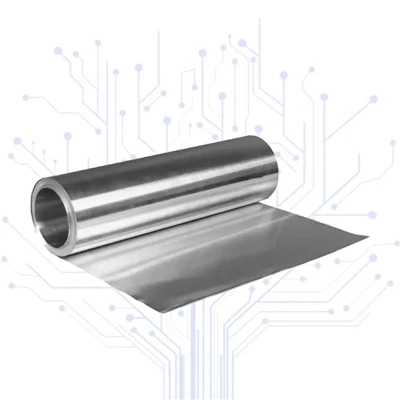
Civen Metal Material (Shanghai) Co., Ltd. is one of the leading manufacturers and suppliers of thin ra bronze foil in China. Welcome to buy bulk durable thin ra bronze foil made in China here from our factory. If you have any enquiry about cooperation, please feel free to email us.
Thin RA Bronze Foil is a cold-rolled copper-tin alloy foil developed for precision components where thin gauge, dimensional consistency and electrical conductivity are important. Multi-stage cold rolling and controlled-atmosphere annealing are used to develop the required mechanical properties and surface condition.
The listed thickness range is 0.01 mm to 0.10 mm, with widths from 5 mm to 400 mm. The foil can be supplied in coil or precision-slit formats for progressive stamping, etching and other fine-component processing.
Key Material
CIVEN Metal processes wrought copper-tin alloys compliant with international metallurgical standards:
| Alloy Standard | UNS Designation | Nominal Composition | Material Characteristics |
|---|---|---|---|
| C5191 | C51910 | Cu-6%Sn, phosphor bronze | Spring properties, fatigue resistance and corrosion resistance |
| C5210 | C52100 | Cu-8%Sn, phosphor bronze | Higher tensile strength and wear resistance for high-stress contact applications |
Performance Features
Fatigue Performance:
The rolled-annealed copper-tin alloy is suitable for components exposed to repeated bending and cyclic mechanical loading.
Elastic Behavior:
Controlled mechanical properties support predictable spring-back and forming performance in precision stamped components.
Surface Finish:
The current product information specifies surface roughness of Ra ≤0.4 μm, supporting applications where controlled surface condition is important.
Thermal Stability:
The current product information indicates suitability for applications exposed to elevated temperatures, with mechanical properties specified for use up to 150°C.
Solderability & Weldability:
The listed material surface condition is suitable for downstream processes including laser welding, resistance welding and tin plating, subject to application-specific process conditions.
Technical Specifications
| Parameter | Specification Range | Test Method / Standard |
|---|---|---|
| Thickness | 0.01–0.10 mm | Laser Micrometer, ±0.001 mm |
| Width | 5–400 mm | Slitting tolerance ±0.05 mm |
| Temper | O, 1/4H, 1/2H, H, EH | ASTM B103 / JIS H3110 |
| Tensile Strength | 350–1100 MPa, temper dependent | ASTM E8 / ISO 6892-1 |
| Elongation | 2–40% | ASTM E8 / ISO 6892-1 |
| Electrical Conductivity | 12–20% IACS | Eddy Current Conductivity Meter |
Manufacturing & Quality Control
Production Workflow
Raw Material Verification: Incoming copper and tin materials are checked by spectral analysis before entering the production process.
Cold Rolling: Multi-roll mills are used for progressive thickness reduction, with hydraulic gap control supporting consistent foil dimensions.
Controlled Atmosphere Annealing: Continuous furnaces with hydrogen-nitrogen protective atmospheres are used for controlled annealing and oxidation protection.
Precision Slitting: Razor and shear slitting systems are used to control slit width and edge condition, with the current process specifying burr height below 5% of foil thickness.
Quality Inspection Protocol
Laser Thickness Gauging: Online monitoring tracks thickness variation along the coil length.
Mechanical Testing: Tensile strength, yield strength and elongation are checked using universal tensile testing equipment according to the specified production requirements.
Metallographic Analysis: Optical microscopy is used to evaluate grain structure and phase distribution.
Surface Defect Detection: Automated optical inspection checks the foil surface for pinholes, scratches and visible inclusion marks.
Applications
Automotive Connectors:
Used for terminal springs, relay blades and sensor contact elements where thin-gauge material, spring behavior and electrical conductivity are required.
Consumer Electronics:
Suitable for miniature battery connectors, shielding components and flex-cable stiffeners used in compact electronic devices.
Telecommunications:
Applicable to high-frequency switch components and lead frames requiring thin, formable conductive material.
Precision Instruments:
Used for diaphragms, bellows and instrument suspension strips where controlled thickness and mechanical properties are important.
Customization & OEM Supply
Dimensional Adaptability:
Custom thicknesses down to 0.008 mm and non-standard slit widths are available subject to engineering review.
Surface Treatments:
Available options include pre-cleaning, passivation and specific surface roughness profiles for downstream plating and processing requirements.
Traceability:
Each master coil is assigned a unique lot number linked to Mill Test Certificates (MTC), including chemical analysis and mechanical test results.
Packaging & Delivery
Moisture Protection:
Coils are vacuum-sealed in anti-corrosion VCI film with silica gel desiccants to reduce exposure to moisture during storage and transportation.
Physical Protection:
Coils are packed in export-grade fumigated wooden crates or heavy-duty cardboard boxes. Available core diameters include 75 mm, 150 mm and 300 mm.
Shipping & Documentation:
Sea freight, air cargo and express courier options are available according to order requirements. Shipment documentation can include the Certificate of Origin, MSDS and Mill Test Certificate (MTC).
FAQ
Hot Tags: thin ra bronze foil, China thin ra bronze foil manufacturers, suppliers, factory, Beryllium Copper Foil, High precision RA Brass Foil, RA Bronze Foil, RA Copper Foil, Rolled Brass Foil, Treated RA Copper Foil