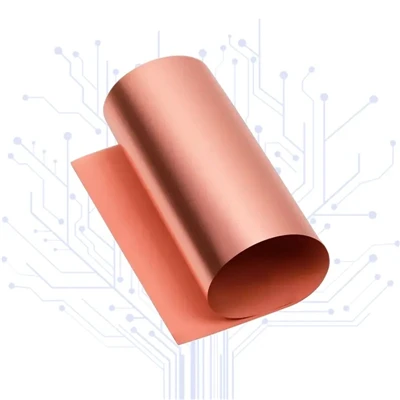
A copper strip that reads 15 percent elongation will stretch to 115 mm from a 100 mm gauge length before it fractures. That single figure predicts whether the strip will survive a stamping die, a lead-frame moulding cycle or a hand-formed architectural fold. It is the mechanical spec buyers most often under-specify, and the source of a surprising number of cracked parts.
How is elongation measured and what does it tell you?
A sample is pulled in tension until it breaks, the final length is measured against the original, and the increase is reported as a percentage. It is a measure of ductility - how much plastic deformation the metal takes before fracture - not of strength. The two move in opposite directions: a strip worked hard to raise its yield strength gives up elongation, while a soft annealed strip stretches more but yields easily. Any honest spec therefore names both, because elongation alone describes only half the forming behaviour.

Temper governs the number. Soft annealed copper strip can show elongation well above 40 percent; half-hard grades sit in the teens to twenties; full-hard stock drops into single digits. The right choice is the softest temper that still meets the finished part's strength requirement - extra ductility is cheap insurance against cracking.
Why does a lead frame care so much?
In a semiconductor lead frame, the copper strip carries the die's connections out to the pins. During plastic encapsulation it sees roughly 180 C for a few seconds, then the pins are trimmed and formed to tight tolerances. Strip with too little elongation cracks at the form or splits during moulding, and the whole frame is scrap. That is the reason a dedicated copper strip for lead frame is specified with ductility controlled for the forming step, not just with a conductivity figure.

Decorative work asks a different question. A decorating copper strip folded around a corner or a curved façade needs enough elongation to take a tight radius without orange-peeling the surface - a rough, dimpled finish that appears when large grains deform. There the grain size matters alongside the elongation number, since a coarse grain will show even when the strip technically stretches far enough.
What should go on the drawing?
Name the temper, the minimum elongation over a stated gauge length, and the tightest bend radius the part will see. If the strip will be welded later, note that too: a heavily worked strip loses ductility in the heat-affected zone. For general forming, a standard copper strip in the right temper is usually enough; for a demanding draw or fold, ask us for a grade with the grain size controlled as well.
Send the part geometry, the forming operation and the strength you need in the finished piece, and we will recommend a temper with elongation to match.
Is higher elongation always better?
No. A very soft strip may not hold the shape or strength the part needs. Specify the minimum that survives forming with margin, not the highest number available.
How does elongation relate to bend radius?
They correlate but are not the same test. Bend radius is a practical forming limit; elongation is a tensile measurement. Use both when the part has tight bends.
Does thickness change elongation?
Slightly, through grain structure and rolling reduction. Thin strip is often worked harder and can show lower elongation than heavier gauge at the same nominal temper.