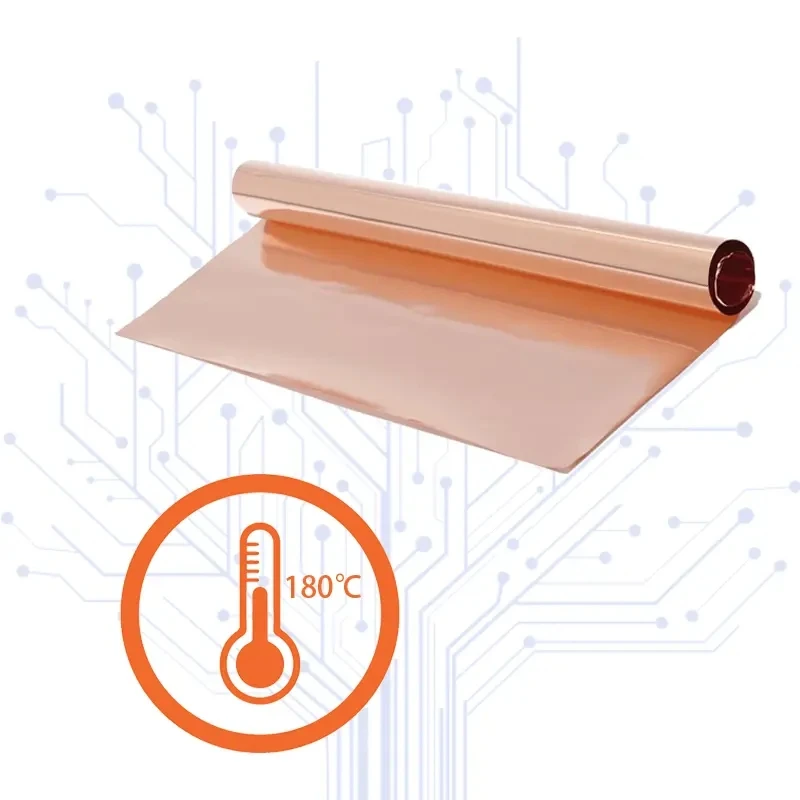
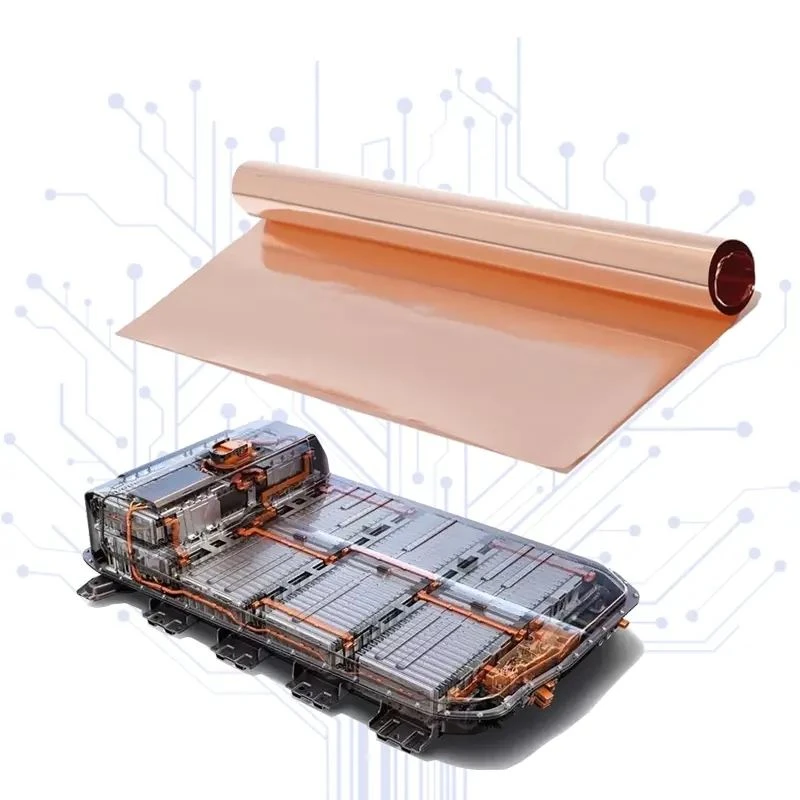
Civen Metal Material (Shanghai) Co., Ltd. is one of the leading manufacturers and suppliers of high-temperature treated ra copper foil in China. Welcome to buy bulk durable high-temperature treated ra copper foil made in China here from our factory. If you have any enquiry about cooperation, please feel free to email us.
High-Temperature Treated RA Copper Foil for Electronic Substrates
High-Temperature Treated RA Copper Foil combines a rolled-annealed copper structure with a controlled surface treatment for applications where copper must withstand elevated processing temperatures while maintaining mechanical and electrical performance.
Precision cold rolling and controlled hydrogen-nitrogen thermal treatment are used to develop a uniform grain structure and improve resistance to recrystallization and softening. For applications where dimensional control is the primary requirement, High-Precision RA Copper Foil provides another material option.
Key Material
High-Purity Copper
The base material is high-purity cathode copper with a copper content of ≥99.99%, specified as Cu-ETP or Cu-OF.
Controlled Grain Structure
Multi-pass cold rolling and controlled-atmosphere annealing produce a uniform equiaxed grain structure to support mechanical stability and repeated bending.
Surface Treatment
A proprietary anti-oxidation passivation barrier is applied to the copper surface. Mechanical or chemical roughening can also be specified for applications requiring increased adhesion to polyimide (PI) or liquid crystal polymer (LCP) films.
Performance Features
High-Temperature Stability
The material retains mechanical integrity and resists oxidation under elevated-temperature conditions. The current specification reports no surface discoloration at 300°C for 60 minutes in the thermal-resistance test.
Flexural Endurance
The equiaxed grain structure supports repeated dynamic bending, with a reported fatigue life exceeding 150,000 MIT folding cycles at 18 μm thickness.
Peel Strength
Peel strength remains at ≥0.8 kN/m with PI substrates after multiple lead-free reflow cycles at 260°C. For applications where bonding performance is the primary material requirement, High-Peel-Strength RA Copper Foil can also be considered.
Dimensional Stability
Controlled residual stress helps reduce curling and wrinkling during chemical etching and other downstream processing.
Technical Specifications
| Parameter | Specification Range | Test Standard |
|---|---|---|
| Purity | ≥99.99% Cu | ICP-OES |
| Thickness | 12 μm, 18 μm, 25 μm, 35 μm (±5%) | Beta-ray gauge |
| Surface Roughness (Rz) | 0.8–2.5 μm (Matte / Shiny options) | JIS B 0601 / ISO 4287 |
| Tensile Strength | 350–450 MPa at room temperature | IPC-TM-650 2.4.18 |
| Elongation | ≥15% | IPC-TM-650 2.4.18 |
| High-Temperature Oxidation Resistance | No surface discoloration at 250°C for 30 min | SEM / Visual |
| Electrical Conductivity | ≥98% IACS | ASTM B193 |
Manufacturing & Quality Control
Precision Rolling
High-precision Sendzimir mills are used to maintain thickness uniformity, with the current process specification controlling variation within ±3 μm across coil widths.
Controlled Atmosphere Annealing
Continuous bright annealing is performed under hydrogen-nitrogen protective atmospheres to control the copper's grain structure and surface condition.
Automated Inspection
100% automated optical inspection is used to identify pinholes, metallic inclusions, and edge cracks.
Laboratory Verification
Production lots undergo tensile testing, surface profiling, and glow discharge mass spectrometry (GD-MS) analysis for material verification.
Applications
Flexible Printed Circuits
Used for dynamic hinge circuits in foldable displays and flexible circuits for medical probes, where repeated bending and thermal stability are important.
Electric Vehicle Electronics
Suitable for BMS flexible flat cables and laminated busbars used in electric vehicle electrical systems.
High-Frequency Transmission
Applied to 5G antenna modules and millimeter-wave communication substrates requiring controlled copper foil characteristics.
Semiconductor Packaging
Suitable for Chip-on-Flex (COF) substrates requiring fine-line etching, including applications with line/space requirements of ≤15 μm.
Customization & Supply
High-Temperature Treated RA Copper Foil can be specified according to downstream processing and substrate requirements.
• Slit Widths: 10–620 mm
• Core Diameters: 3-inch (76 mm) and 6-inch (152 mm)
• Adhesion Coatings: Available for specific dielectric resins including PI, PET, PTFE, and LCP
• Samples: A4 sheet samples and 50 m trial slit coils are available
Packaging & Delivery
The foil is packaged to protect the treated copper surface from moisture, contamination, and handling damage during transportation.
• Anti-static vacuum-sealed polyethylene bags
• Silica gel desiccant
• Suspended foam end-caps
• Fumigation-free wooden export crates
• Temperature-controlled storage at 20°C ±5°C
• Relative humidity below 60%
Stock specifications are listed with a 7–10 business day shipping lead time, while custom production runs require 20–25 business days.
FAQ
Hot Tags: high-temperature treated ra copper foil, China high-temperature treated ra copper foil manufacturers, suppliers, factory, Copper Nickel Foil, High Precision RA Copper Foil, RA Bronze Foil, RA Copper Foil, Rolled Brass Foil, Treated RA Copper Foil